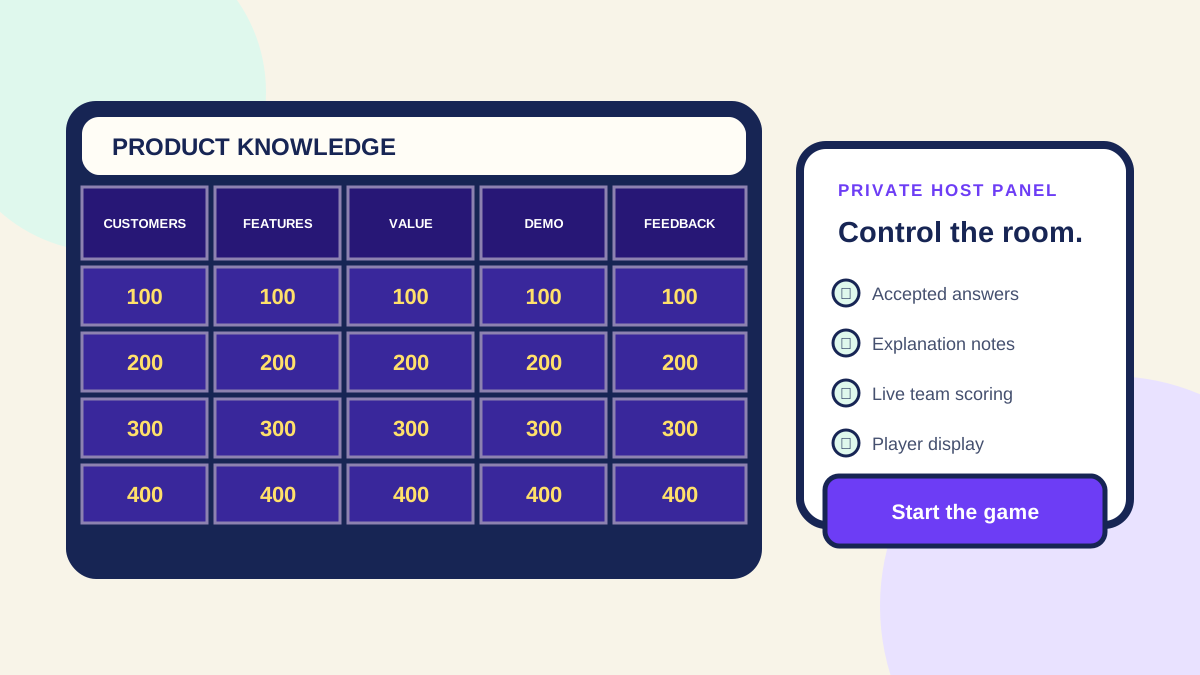
Choose your board
A spoken or text-based music quiz for a staff social or party. This board uses music knowledge rather than song clips, so players can take part without hearing a recording or recognizing a particular voice.
- This original board has five categories with five clues each, worth 100, 200, 300, 400 and 500 points. Suggested values move from accessible recall to a more specific fact or a reasoning step.
- The questions and answers are free to read here. Quiz Champ is an independent game maker, not affiliated with or endorsed by the television show.
Set expectations before the music round
The five categories are Instruments, Music language, Artists and groups, Classical connections, and Musical numbers. This is a read-aloud question board. It contains no licensed recordings, song lyrics or automatic name-that-tune round.
- Show the category names when forming teams so people with different musical interests can mix.
- Accept surnames for composers and familiar stage names for performers. Do not require perfect pronunciation when the answer is clearly identified.
- Let teams discuss quietly for a host-timed 15 seconds. For the calculation category, read the numbers twice and offer the same extra time to everyone.
Instruments
These clues describe how an instrument works. The last clue tests a distinction between material and instrument family.
-
100 points. On an acoustic piano, pressing a key makes a small hammer strike these.
-
200 points. This string instrument is usually held under the chin and played with a bow; its larger orchestral cousin is the viola.
-
300 points. This brass instrument commonly changes pitch using a long sliding section instead of a set of valves.
-
400 points. This large string instrument rests on an endpin and is played upright between the seated player's knees.
-
500 points. Although often made of brass, the saxophone belongs to this orchestral instrument family because it uses a reed.
Reveal answer
Woodwind
Material alone does not determine the family.
Music language
Use the conventional meaning in musical notation or performance.
-
100 points. This term describes how fast or slowly a piece is played.
Reveal answer
Tempo
Accept tempo. Pitch concerns high and low notes.
-
200 points. This word means a gradual increase in loudness.
Reveal answer
Crescendo
It describes getting louder, not automatically getting faster.
-
300 points. This symbol raises a written note by one semitone in ordinary notation.
Reveal answer
A sharp
Accept sharp or the sharp sign.
-
400 points. This term describes singing without instrumental accompaniment.
Reveal answer
A cappella
Accept a capella as a spelling variation.
-
500 points. This interval spans eight letter-name steps, from one C to the next C.
Reveal answer
An octave
Count C, D, E, F, G, A, B, C inclusively.
Artists and groups
The clues use established names and locations, not current chart positions.
-
100 points. John, Paul, George and Ringo are the best-known lineup of this band.
Reveal answer
The Beatles
Accept Beatles.
-
200 points. This Swedish pop group's name uses the initials of Agnetha, Björn, Benny and Anni-Frid.
Reveal answer
ABBA
Accept ABBA.
-
300 points. This singer and songwriter wrote Jolene and I Will Always Love You.
Reveal answer
Dolly Parton
The clue asks for the songwriter, not a later performer of one song.
-
400 points. Graceland, Elvis Presley's home, is in this Tennessee city.
-
500 points. This Jamaican musician fronted the Wailers and recorded the album Exodus.
Classical connections
Titles are sufficient; players do not need to sing, identify a recording or name a key signature.
-
100 points. This composer wrote the ballet The Nutcracker.
-
200 points. The Four Seasons, a set of violin concertos, was written by this Italian composer.
Reveal answer
Antonio Vivaldi
Accept Vivaldi.
-
300 points. This composer wrote the opera The Magic Flute.
-
400 points. This German composer wrote the piano piece commonly called Für Elise.
Reveal answer
Ludwig van Beethoven
Accept Beethoven.
-
500 points. The orchestral suite The Planets was composed by this English musician.
Reveal answer
Gustav Holst
Accept Holst. The suite uses astrological character ideas rather than a modern planet inventory.
Musical numbers
State the unit with the answer. These clues combine musical vocabulary with explicit calculations.
-
100 points. A duet normally has this many performers or musical parts.
Reveal answer
Two
Accept two; the clue asks about the term, not instruments each person might play.
-
200 points. A quartet normally has this many performers or musical parts.
Reveal answer
Four
Accept four.
-
300 points. Eight bars of 3/4 contain this many quarter-note beats.
Reveal answer
24
Each bar has three quarter-note beats: 8 × 3 = 24.
-
400 points. At a steady 120 beats per minute, half a minute contains this many beats.
Reveal answer
60
120 × 0.5 = 60 beats; no tempo change is assumed.
-
500 points. At 60 quarter-note beats per minute, eight complete bars of 4/4 last this many seconds.
Reveal answer
32 seconds
Eight bars × four beats = 32 beats; at 60 beats per minute, each beat lasts one second.
Copy the board into Quiz Champ
Open the creator, choose Standard format, and manually enter each category, clue, accepted answer and judging explanation. The button opens the builder; it does not import this article or load a ready-made version of this board.
- Prepare all 25 clues before the event. Use the preview to check the text and answer for every tile. Saving or hosting requires an account; check the current plan and room limits before inviting players.
- Keep the host screen and answer notes private. Share only the player display.
- In Spoken Classic, a participant must buzz through Quiz Champ before answering aloud. In typed mode, the first buzzer submits the answer in the game. An external chat message does not register a response.
- After a registered response, reveal and judge. The current host dashboard adds the tile value for Correct and adds zero for Incorrect. Announce any manually tracked house rules before play.