Set up a quiz children and adults can share
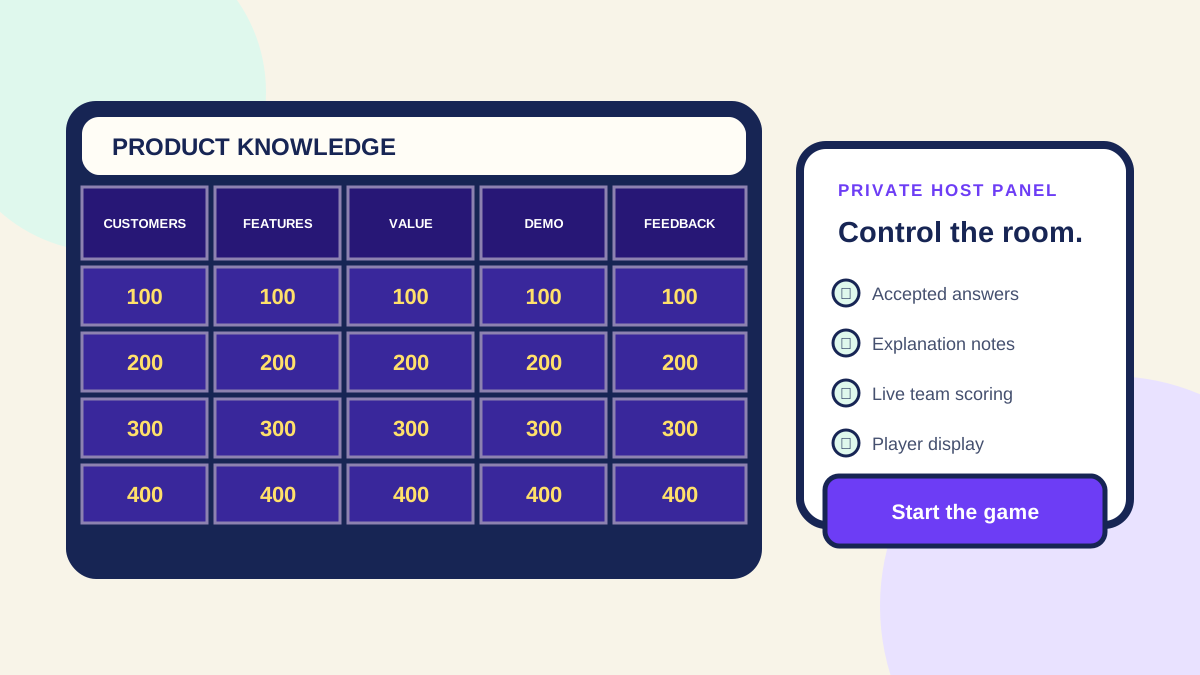
These original questions make a five-category board. The 100- and 200-point clues are warm-ups; the higher values invite a short team discussion. Difficulty depends on your family, so swap values before playing if a clue is familiar to everyone.
- Make mixed-age teams. Rotate who gives the final answer after every category, so adults do not answer everything.
- For a short game, use the first three questions in each category. Allow about 20 minutes including a practice clue and the ending.
- Read every clue aloud. Offer the same hint to every team if the wording is unfamiliar; agree on a hint rule before starting.
- Keep this answer page on the host device. Show players the game display, not the answer key.
Practice before points: three plus two
Read this unscored example aloud: You have three apples and receive two more. Answer: five. Let a child suggest the answer, an adult operate the device and another teammate read the clue. Rotate these roles in the scored board; adults should leave time for younger players to think.
- Open the optional hint before revealing the answer if the group needs help. Give the same hint opportunity to each team.
- For academic review, use the classroom page and select material already taught; this family board is a social activity.
Animal detectives
Start here with younger players. For a harder round, ask for the answer before giving a choice. Suggested suitability: 100-200 for a reader-assisted warm-up, 300 for shared recall, 400-500 for optional team discussion. Familiarity matters more than age.
-
100 points. How many legs does a spider have?
Optional hint
Count four pairs.
Reveal answer
Eight
Count four pairs. An insect has three pairs.
-
200 points. Is a penguin a bird, a mammal, or a reptile?
Optional hint
Look for feathers rather than flight.
Reveal answer
A bird
Being unable to fly does not stop a penguin from being a bird.
-
300 points. What do we call a young frog before it develops into its adult form?
Optional hint
Its name starts with T.
Reveal answer
A tadpole
Accept tadpole; the clue asks for the life stage, not a type of frog.
-
400 points. Does a dolphin breathe using lungs or gills?
Optional hint
Think about what happens when it surfaces.
Reveal answer
Lungs
Dolphins are mammals and come to the surface to breathe air.
-
500 points. How many legs does an adult butterfly have?
Optional hint
Count three pairs, including the small front pair.
Reveal answer
Six
Butterflies are insects. In some butterflies, the front pair is small and easy to miss.
Space explorers
Use these five clues as a first step into astronomy. They ask about the eight planets in our solar system, not dwarf planets or planets around other stars. Suggested suitability: 100-200 for a reader-assisted warm-up, 300 for shared recall, 400-500 for optional team discussion. Familiarity matters more than age.
-
100 points. Which planet do we live on?
Optional hint
Name our home planet.
Reveal answer
Earth
Accept Earth; no continent or country is needed.
-
200 points. Which planet is commonly called the Red Planet?
Optional hint
Its nickname describes a rusty color.
Reveal answer
Mars
Its rusty-looking surface gives it the nickname.
-
300 points. How many planets are in our solar system?
Optional hint
Do not count dwarf planets.
Reveal answer
Eight
Pluto is classified as a dwarf planet and is not included in the eight.
-
400 points. Which planet is the largest in our solar system?
Optional hint
Its name begins with J.
Reveal answer
Jupiter
The question is about size, not closeness to the Sun.
-
500 points. Which of the eight planets is farthest from the Sun?
Optional hint
It comes after Uranus in the outward order.
Reveal answer
Neptune
Neptune is the outermost planet in the eight-planet classification.
Word workshop
These clues use written English. Let a team write a word down if hearing the letters is difficult. Suggested suitability: 100-200 for a reader-assisted warm-up, 300 for shared recall, 400-500 for optional team discussion. Familiarity matters more than age.
-
100 points. What is the opposite of the word empty?
Optional hint
Imagine a cup with no room for another drop.
Reveal answer
Full
Accept full; do not require a complete sentence.
-
200 points. How many letters are in the English word FAMILY?
Optional hint
Point to one letter at a time.
Reveal answer
Six
F, A, M, I, L, Y. Display the word as well as reading it.
-
300 points. Which letter is silent at the start of the English word knee?
Optional hint
Compare the spelling with the first sound.
Reveal answer
K
Read knee naturally, then let players inspect the spelling.
-
400 points. What do we call a word such as level that reads the same forward and backward?
Optional hint
Read LEVEL from each end.
Reveal answer
A palindrome
Accept palindrome. Spelling aloud is not required.
-
500 points. Rearrange every letter of LISTEN to make a word meaning making no sound.
Optional hint
Write the letters separately and start with S.
Reveal answer
Silent
SILENT uses L, I, S, T, E, N exactly once each.
Number nook
These are short reasoning questions. Paper is fine; decide together whether calculators belong in your game. Suggested suitability: 100-200 for a reader-assisted warm-up, 300 for shared recall, 400-500 for optional team discussion. Familiarity matters more than age.
-
100 points. You have three apples and receive two more. How many apples do you have?
Optional hint
Count two more after three.
Reveal answer
Five
3 + 2 = 5.
-
200 points. How many sides does a triangle have?
Optional hint
Trace the three straight edges.
Reveal answer
Three
A triangle has three straight sides.
-
300 points. A game starts at 2:15 and lasts 30 minutes. At what time does it finish?
Optional hint
Move the minute hand forward half an hour.
Reveal answer
2:45
The hour does not change in this example.
-
400 points. Four people share 12 cookies equally. How many cookies does each person get?
Optional hint
Deal one cookie to each person repeatedly.
Reveal answer
Three
12 divided by 4 is 3.
-
500 points. A square has sides 6 centimeters long. What is its perimeter?
Optional hint
Add the four equal edge lengths.
Reveal answer
24 centimeters
Add all four sides: 4 × 6 = 24. Perimeter is distance around the edge, not area.
Around the house and world
These clues move from everyday objects to a geography challenge. Suggested suitability: 100-200 for a reader-assisted warm-up, 300 for shared recall, 400-500 for optional team discussion. Familiarity matters more than age.
-
100 points. Which tool tells you the temperature: a ruler, a thermometer, or a compass?
Optional hint
Choose the instrument that measures hot and cold.
Reveal answer
A thermometer
The choices describe length, temperature, and direction.
-
200 points. Which direction is opposite north?
Optional hint
Use the north-south pair on a compass.
Reveal answer
South
A compass rose can be a useful explanation after the reveal.
-
300 points. How many months are in one calendar year?
Optional hint
Count January through December.
Reveal answer
Twelve
This question uses the familiar January-to-December calendar.
-
400 points. Which ocean is the largest on Earth?
Optional hint
Its name begins with P.
Reveal answer
The Pacific Ocean
Accept Pacific. This is about ocean size, not the ocean nearest your home.
-
500 points. If you cross the equator traveling north, which hemisphere do you enter?
Optional hint
Use the direction of travel to choose north or south.
Reveal answer
The Northern Hemisphere
The equator separates the Northern and Southern Hemispheres.
Turn the questions into your family board
Open the game maker and enter the five category names. Add each question as a clue, its answer as the accepted answer, and the explanation as a host note or explanation. Preview the board before inviting the family; these questions are a manual copy resource, not a preloaded template.
- In a live room using spoken answers, a player must buzz in through the game before answering out loud. The host then reveals and judges the answer.
- With typed answers, wait for the participant's submitted response before revealing and scoring.
- Agree that an equivalent answer counts. For example, Pacific and Pacific Ocean mean the same thing.
- Keep one unused numerical tie-breaker for a tied ending. Announce that rule before the first clue.